Grassroots football is filmed more than it has ever been. Phones go up on touchlines, parents hold cameras, clubs buy a pair of action cameras and a mast. And then the footage goes nowhere. It sits on memory cards and laptops, because turning ninety minutes into a goal clip, keeping an honest record of who played and posting the result by Sunday night is a second job that nobody at a volunteer club signed up for.
Pitchcut exists to do that second job. It was built inside a real amateur club, to take the footage, the team sheet and the result, and turn them into the video, the stats and the posts a club wants. The aim is simple: a fifteen-year-old who scored on Saturday can watch it back on Sunday, and their parents can see it too, without anyone staying up to edit.
Who it is for
Pitchcut is for grassroots and amateur clubs: Sunday leagues, youth sides, community clubs, small academies. The people it is for are the ones doing the volunteering: the secretary with a spreadsheet, the coach who keeps the sheet on the back of a clipboard, the parent who always films. It is also for the players, who are the point of all of it. Most of them are young, and that shapes everything below.
What it does
It turns a match recording into one match video, lets people at the club cut clips from it, builds player stats from a squad sheet, and drafts social posts for a person to approve. The step-by-step version is on how it works, and what each person at a club gets is on for clubs. Around that sits the ordinary running of a club: roster, teams, seasons, fixtures, results, sponsors and discipline. They are there because the footage and stats need to know who the players are and which match they played, not because Pitchcut wants to be your club’s filing cabinet.
What it deliberately doesn’t do
- It doesn’t post on its own. Everything it drafts waits for a person at the club.
- It doesn’t make you an editor. There is no timeline of tracks, transitions or effects. A clip is a start, an end, a crop and a straighten, because a highlight does not need more, and a club does not need another editing package to learn.
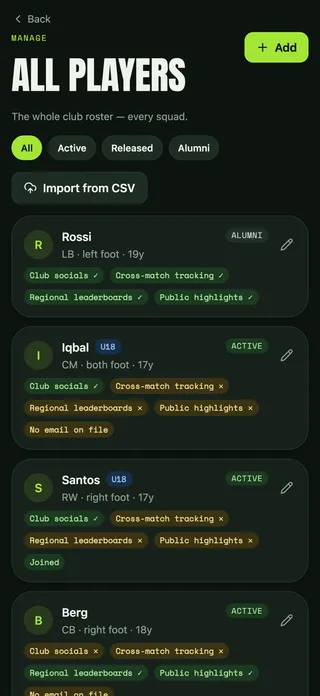
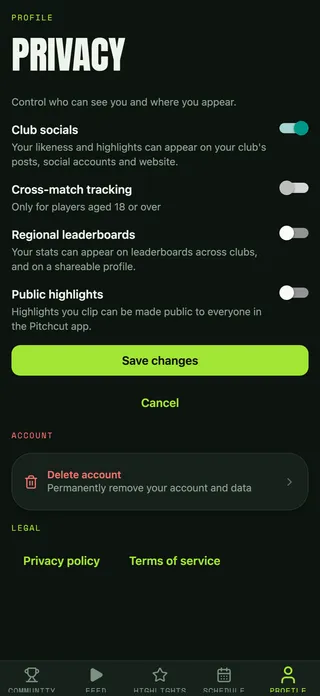
- It doesn’t treat young players like adults. Consent is separate for each thing a player might appear in, and for a young player it belongs to a parent or guardian. The detail is in the privacy policy’s Consent and Children’s data sections, and it is not repeated here.
- It doesn’t sell what it holds. The policy’s Sharing section sets out who receives data and why.
- It doesn’t pretend to be a scheduling app. Plenty of tools will send reminders. Pitchcut starts from the match footage and works outward.
One club’s data stays with that club
Pitchcut serves many clubs from one system, and each club’s players, footage, stats and posts are kept separate from every other club’s. A club can also have several teams, and a player account is limited to its own teams. How the separation is enforced, what is visible and what can leave a club are in the privacy policy’s Footage and Security sections.
A small, independent project
Pitchcut is built and run by a small independent team, together with the clubs that use it. That means it changes with what clubs tell us: a feature that is not working for a real coach gets rebuilt, not defended. If you run a club and would like to try it, or you have an idea for it, we would like to hear from you. The way to reach us is the support page.